
Though the primaries will officially take place in Illinois later in March, early voting began on Feb. 5 for suburban Chicago counties. Since Illinois allows all U.S. citizens who will be 18 and above by the midterms on Nov. 3 to vote in the primaries, even if they are still 17 at the time of the primary election, many junior and senior students have the opportunity to vote in March.
The primary elections will determine the Democratic, Republican, and Independent candidates for various positions within the midterm election. While positions for the U.S. Congress are up for election, the Illinois primaries also see the election of members of the state legislature, including Illinois’s state congress, as well as the state’s governor, lieutenant governor, comptroller, and treasurer, and many local positions. Noah Hanif ’26 notes that some elections are more significant for voters to pay attention to.
“In the U.S., the incumbency advantage is very prevalent, where the person who currently serves in office has a very high chance of winning the primary and general election again,” Hanif said. “Races where the incumbent stepped down are the ones that are most important; like the U.S. Senate and Illinois Congressional district 9 give voters a chance to decide who will hold the incumbency advantage.”
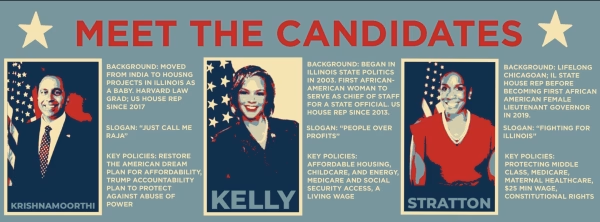
For the Senate, U.S. Sen. Dick Durbin (D-IL) announced that he would not seek re-election, opening up his position to several Democratic candidates. Rep. Raja Krishnamoorthi, Lt. Gov. Juliana Stratton, and Rep. Robin Kelly are running for the position he held for six terms. Don Tracy is the likely Republican candidate for the Senate seat, though, according to the New York Times, Illinois’ record as a blue state puts him against the odds to win in the midterm elections.
(Zoe Theobald)
According to The Hill, Krishnamoorthi leads in polls, with 31 percent of Democratic Illinois voters expressing support for him. However, Stratton has the endorsement of Gov. J.B. Pritzker. According to Political Action Club sponsor Andrew Conneen, endorsements from major candidates can help a campaign succeed.
“When significant party leaders endorse candidates, that’s a sign of a serious candidacy,” Conneen said. “J.B. Pritzker also contributed significant campaign money for Lieutenant Governor Stratton.”
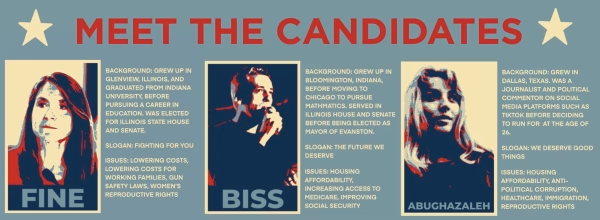
The other competitive race prompted by the retiring of the incumbent is occurring in Illinois’ 9th district, which encompasses the homes of some Stevenson students. State Rep. Jan Schakowsky has announced that she will not be seeking re-election in 2026, opening her position to several candidates. Schakowsky has expressed support for Evanston Mayor Daniel K. Biss as a hopeful candidate for the seat. However, he is challenged by State Sen. Laura Fine and journalist Kat Abughazaleh, who has gained traction due to her large social media presence.
Although the Senate and District 9 races are considered important due to the retirement of long-time politicians, Hanif believes these races have also gained attention due to the candidates’ policies. To be more specific, Hanif notes that their policies have appealed to potential voters, thus raising awareness for their campaigns.
“The Senate and 9th district races are exposing the priorities of Illinois voters, [where] topics such as mega-donor campaign funding being associated with “establishment” politicians and responses to the Trump administration are at the forefront of policies and attacks,” Hanif said. “Politicians are talking about the “standard” topics like healthcare, social security, and minimum wage, but the aforementioned topics are gaining much more publicity, something that hasn’t been seen before.”
While some positions face competition, other positions have long been held by the same candidate, and an upset in the primary election is not expected. In the election for Illinois governor, J.B. Pritzker is running for a third term in office with his new running mate Christian Mitchell as lieutenant governor, given that his former lieutenant governor Juliana Stratton is now running for a Senate position.
“Incumbency advantage is what roots candidates like J.B. Pritzker, who continues to run to build a repertoire for future campaigns,” Hanif said. “Pritzker has been governor for seven years, and has not ruled out running for president. Establishment politicians run again to build up their experience, potentially in hopes for another race.”
Although having prior political experience may boost the chance of being nominated, larger corporate donors often provide more established candidates with a large advantage. Additionally, support from the party itself typically lends a lot of help to a nomination. Conneen describes how financial support and endorsements help all candidates win elections.
“What helps candidates get nominated is the name recognition of candidates, and also how much support they are getting from the party itself,” Conneen said. “Their campaign fundraising also plays a large role in whether the candidates will be able to win the party nomination.”
While campaigns may work to gain votes using measures like funding, voter mobilization in the primaries has been declining in recent years. According to The State Journal-Register, data from the Illinois State Board of Elections shows only 21.7 percent of registered voters voted in the 2022 primaries—the second-lowest rate in the past 40 years. Hanif raises concern over the lack of voter turnout, especially in younger populations, and emphasizes why voting is important.
“It’s important for young people to vote because we are directly impacted by the policies that our government makes—the smaller the election is, the more influential it is on our daily lives,” Hanif said.
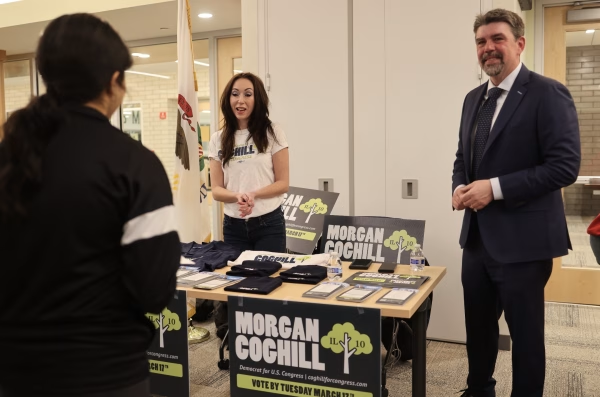
Candidates carry similar concerns to Hanif about low turnout, especially from young voters. To increase participation, candidates are reaching out to potential voters in order to gain support. Some candidates’ campaigns have reached Stevenson, where the Political Action Club hosts the Campaign Fair event to provide an opportunity for students to meet the candidates and learn about their stances, as well as register to vote. According to Conneen, Political Action Club seeks to encourage students, that are of age, to participate in politics through events like these.
“Whether it be serving as election judges for Lake County or if students express interest in supporting a candidate or a party, Political Action Club creates events where all students are invited and both parties are invited,” Conneen said. “Candidates from both parties are invited to create conversation points where students can find out about the issue stances of candidates and parties and find out how they can get involved.”
Political Action Club also aims to help 17 and 18 year old students get registered and ready to vote. In addition to hosting in-person registration events, they educate students on how to register. Many like Conneen encourage participation in the elections, especially from young voters, given that the primary results reflect the desires of a party’s members. Conneen cites the importance of voting in the primaries in creating the political future of the nation.
“It’s important for all voters to know that primary elections are the elections that can shape the future of each party,” Conneen said.