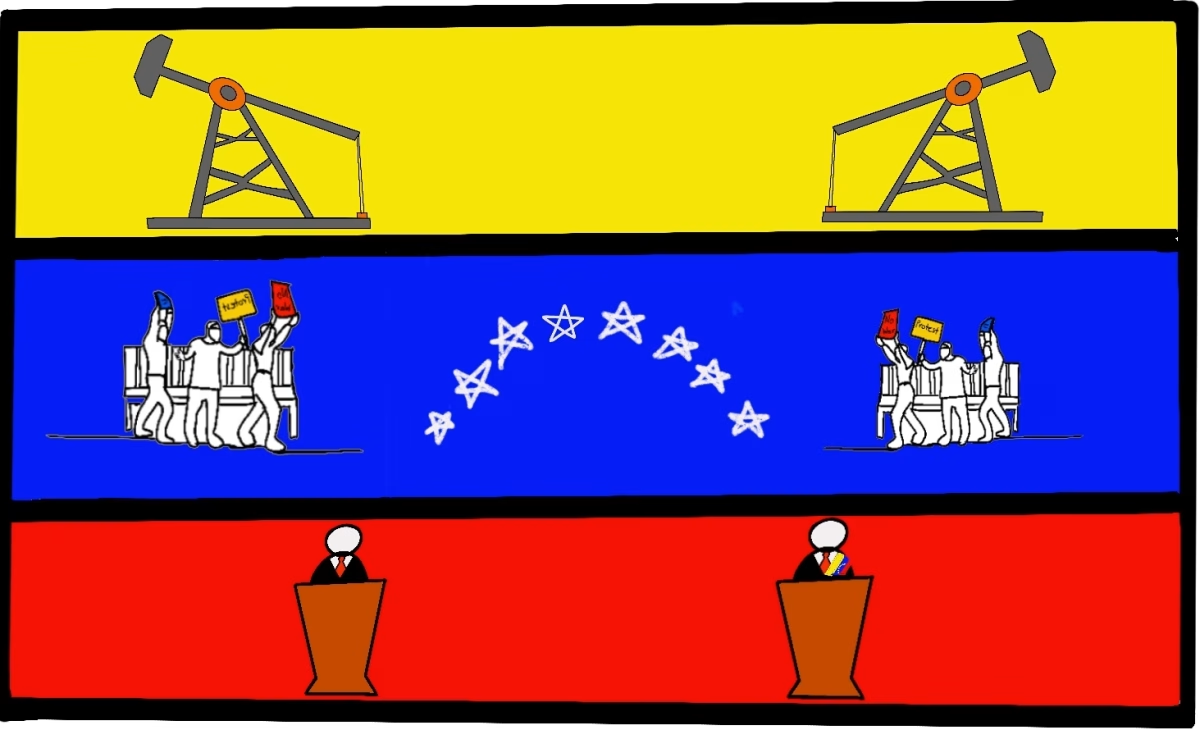
In the early morning on Jan. 3, 2026, the political future of Venezuela was thrown into uncertainty. The United States of America captured president, Nicolás Maduro, in a military operation, igniting debate in Washington D.C. and Caracas about foreign policy, international law, and regional stability.
President Donald Trump said the operation targeted Maduro as a part of broader efforts to disrupt drug trafficking networks and national security threats connected to Venezuela’s government, according to a report by TIME. Additionally, according to Brookings, immediately after capturing Maduro, President Donald Trump announced that this operation was only the beginning, and that the Trump Administration expects it can control the remaining pillars of the Maduro regime through offshore military presence and oil embargo.
Maduro’s removal ends a period of leadership that began in 2013 and followed more than two decades of rule by the socialist movement established under former President Hugo Chávez.
“The greatest change in Venezuela right now is that it has reached the end of a regime that had been in control for 27 years,” said Dr. Ana Gil-Garcia, a Northeastern Illinois University professor of educational leadership.
Gil-Garcia is also a founder of the Illinois Venezuelan Alliance (IVA), a nonprofit dedicated to serving, supporting, and advocating for the Venezuelan community in Illinois through community outreach, educational programming, and public discussions on Venezuela’s political and humanitarian crisis. The organization has been active since 2017 and has grown in size over the years.
Maduro’s removal from power represents a shift in Venezuela’s political system and marks the collapse of the governing structure that had ruled the country for more than two decades. The shift would result in the installment of Vice President Delcy Rodriguez to take over Maduro’s role in order to avoid anxiety regarding future governance.
According to the Council on Foreign Relations, a nonpartisan publisher, the Trump Administration had framed the operation as necessary to curb the flow of drugs from Latin America to the U.S.. Furthermore, ABC 7 Chicago shares that a 25-page-long indictment accuses Maduro of cooperating with drug cartels in order to facilitate the shipment of thousands of tons of cocaine into U.S. borders.
Prior to Venezuela becoming a major drug-trafficking hub, the regime began with the Chavez administration in 1998 and continued on through the appointment of Maduro in 2013. According to The Daily Economy, before its political decline, Venezuela was widely regarded by other countries as a symbol of democratic stability, and economic strength in Latin America, buoyed by both oil wealth and competitive elections. Gil-Garcia said that the transformation from a democratic symbol to political decline makes the country’s current condition especially stark.
“Venezuela went from being an icon of democracy in Latin America, one of the richest countries in the Americas, to being a narco regime,” Gil-Garcia said. “The regime ended up taking away the rights of people, closing the media outlets and newspapers, going against the freedom of expression, and destroying any possibility of progress.”
Following the U.S. operation, Venezuelan institutions installed Rodríguez as acting president, a step Rodríguez described as necessary to restore stability, though both she and the country continue to recognize Maduro as the “de jure” president. According to the Associated Press, security forces in Venezuela have restricted independent media coverage and detained critics, journalists, and opposition figures accused of undermining state authority.
The U.S. capture of Maduro and the ensuing political turmoil in Venezuela have directly impacted Venezuelans living in the U.S. According to the U.S. Citizenship and Immigration Services, Venezuela no longer qualifies for Temporary Protected Status, a designation that allowed Venezuelans to live and work legally in the U.S. due to unsafe conditions in their home country. As a result, more than 80 Venezuelans have been deported this previous year, according to a report by the Latin Times.
Gil-Garcia notes that 34 years ago, when she first moved to the U.S., there were only 60 Venezuelans living in Chicago; now, there are around 60,000 Venezuelan residents. Many people who live in Venezuela, such as Maria Lee, believe that outside involvement from foreign powers carries both risk and moral trade-offs.
“Venezuelans have attempted elections, protests, negotiations, international appeals, and sanctions, yet those paths were blocked by repression and external support for the regime,” Lee said. “In theory, peaceful internal resolution is always preferable, but when institutions are captured and dissent is criminalized, options narrow. The goal now should be to have a transition that minimizes harm, restores legitimacy, and allows us, as Venezuelans, to rebuild our country.”
Nonetheless, Lee is hopeful that the U.S. intervention has the potential for enacting positive change. CNN reports that less than a week after the U.S. operation, Venezuela released several dozen political prisoners in what its government called a gesture “to seek peace.”
Political prisoners are defined as “anyone who is arrested because of his or her perceived or real active involvement or supporting role in political movements,” per the Assistance Association for Political Prisoners. Even with the announced release, the Latin Times estimates that nearly 800 political prisoners remain detained in Venezuela as of Jan. 20.
“Since only a few dozen have been released, we are pushing and pushing from here, from outside, from Europe, from Africa, from everywhere where a Venezuelan is,” Gil-Garcia said. “There is no peace if we still have political prisoners.”
As of Jan. 7, Rodríguez declared a 90-day state of emergency that gives security forces broad power to “immediately search and capture” anyone who supports “the armed attack by the United States.” An article by the New York Times (NYT) explains that since the declaration, pro‑regime paramilitary groups known as “Colectivos”, have taken to the streets on motorcycles and in uniform, sometimes armed with assault rifles, establishing checkpoints and patrolling neighborhoods in Caracas and other cities as part of efforts to enforce order and suppress dissent.
One source currently lives in Canada, yet her thoughts remain fixed on going back to her home in Venezuela. She describes the constant fear that has shaped her daily life, including the need to routinely clean out her phone and delete messages in fear of authorities checking her phone. The source mentions the harsh reality of living in scrutiny, feeling followed, listened to, and monitored, an experience that mirrors what many other Venezuelans have been facing.
“Teenagers have grown up with interrupted education, limited opportunities, and a sense that their future is elsewhere, not at home,” Lee said. “Children have experienced malnutrition, school closures, and emotional stress; For many, instability is all they’ve ever known. Across all ages, there is a shared fatigue and grief.”
NYT mentions that many Venezuelans find it difficult to accept that their country is willing to share oil wealth with the Americans who invaded them, especially after three decades of being a lead oil exporter. According to NYT, nearly two weeks ago Trump met with executives from oil companies to discuss his goal of investing $100 billion in Venezuela to upgrade its oil production and distribution. He said that in order to benefit the U.S., Trump expects to sell at least 30 million to 50 million barrels of Venezuelan oil.
“We’ve got millions of barrels of oil left,” Trump said. “We’re selling it on the open market, we’re bringing down oil prices incredibly.”
Trump’s comments come amidst growing debates over the morality of U.S. involvement in Venezuela. Brookings mentions that earlier this month, Trump explicitly and repeatedly stated that the U.S. is now controlling Venezuela; however, Trump’s secretary of state, Marco Rubio, argues that the U.S. continues to have no direct governing role.
At the local level, advocates like Gil-Garcia remain focused on humanitarian efforts and trying to use Venezuelan voices to educate people. In addition, IVA continues to advocate for a democratic transition, beginning with the release of all political prisoners and the restoration of freedom of expression, through hosting discussions in the Chicagoland area. The last discussion took place on Jan. 15.
“We’re going to start looking into years of reconstruction in the country, and I hope that when Venezuela is open, we have a critical mass of young people from the U.S. willing to come and help us rebuild the country,” Gil-Garcia said. “Sometimes we have blocks that [prevent us from doing] more, so please just work to get the message out to the community. And make sure that you meet the Venezuelan kids.”
To continue fighting for reconstruction, both Gil-Garcia and Lee highlight what teenagers could be doing at the high school level to get involved. Pinto mentions that this situation is nowhere near over, so staying educated with reliable news information and student-led advocacy is of utmost importance.
“Support can be meaningful without being political,” Lee said. “Learn and listen, invite Venezuelan speakers, support newcomers in adjusting to a new language or school system, and understand the geopolitics. Most importantly, treat the situation as a human story, not just a headline.”