

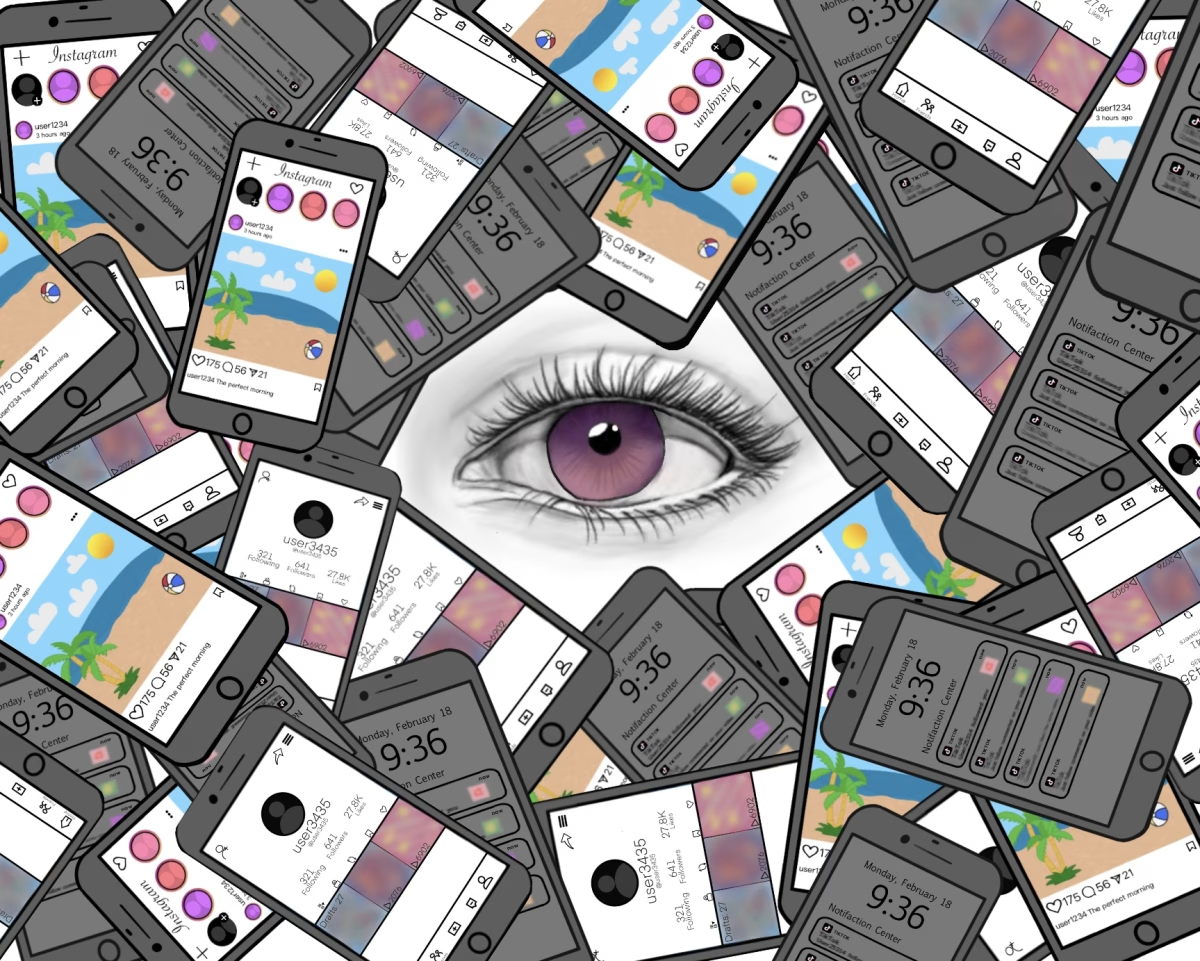
At 2 a.m., Phillip Boyko ’26 was hard at work on his phone, its blue glow illuminating his room. He knew he should have gone to sleep hours ago but lost track of time scrolling on social media. The night went by fast and finally, he fell asleep, his phone still sitting in his hands. When Boyko woke up the next morning, his thoughts immediately turned to the test he had that day and subsequently, how he wished he had used his time the night before studying. He sighed, realizing he had a long day ahead of him.
However, Boyko understands that such social media may impact his life in ways beyond losing sleep or not studying for a test. For Boyko, the same platforms that create a sense of community and belonging can also become a self-feeding cycle of depressing content that disrupts healing.
“The more time you spend on your phone watching social media, the more the algorithm’s gonna keep feeding you things that will [and have affected your mental health],” Boyko said.
Meanwhile, Media Relations Manager Maya Brownstein for the Harvard School of Public Health, attributes this to the fact that social media companies are businesses, and they only make a profit when users continue scrolling. According to Rachel Kelly* ’26, this causes teenagers with existing mental health issues to have a hard time avoiding triggering content on social media.
“I struggle with an eating disorder, and so a lot of content on social media is encouraging eating disorders,” Kelly said. “Even though I don’t engage with it, that definitely puts me in the opposite direction from healing.”
Kelly says prolonged exposure to triggering content has negatively affected her mindset and inhibited her recovery. Even though she has found some content on social media to be supportive of her struggle with an eating disorder, over time it has reinforced her perception that she is not good enough compared to the people she see on social media.
“If I see someone, I assume they must have a better life than me just because they appear better and I’ve seen their social media,” Kelly said. “I’m influenced to think that they have a more successful life.”
Along with Kelly, 46 percent of teenagers reported that social media made them feel worse about their body image, according to a survey by the Boston Children’s Hospital Digital Wellness Lab. English teacher Melissa Mack attributes this worsening of mental health and confidence in oneself to the pure fact that people are often extremely inauthentic on social media.
“I think people look at [social media] without fully realizing that what is being put out there is very carefully curated,” Mack said.
Mack also believes that social media influencers thoughtfully promote themselves to make it seem as if they have the “dream life” even if that may not be the case, which is true of teenagers as well. In a study from the Cybersmile Foundation, 9 out of 10 survey respondents said they feel dissatisfied with their lives and 3 out of 4 indicated they were unhappy with their body image. Cybersmile Wellness and Equity Advisor Dr. Barabara Mariposa argued that more needs to be done to educate people about the risks social media poses to confidence and self-esteem.
With the constant updates from social media, Vishal Sharma* ’27 says teenagers constantly check their phones to not be left out of their social media community. According to Sharma, this has hurt students struggling with mental health issues as other people’s accomplishments begin to overtake their own and people become fixated on what others are doing as opposed to themselves.
“[People need to recognize] that every time you open TikTok and scroll, they never end up feeling better,” Sharma said.
From Sharma’s experience, being aware of potential issues is the beginning of addressing social media’s impact. Claire Burja, one of the psychologists at Stevenson, observes that students who exhibit a preference towards virtual interactions even in situations where it may not be the best way to communicate, potentially harm their relationships.
“I definitely see students having pretty intense conversations that aren’t face to face, and rather, [on] social media apps,” Burja said. “It just gets so complicated [with people] screenshotting conversations and then texting a different group.”
Sharma adds these types of conversations are especially challenging for people who struggle with their self-esteem. Students aren’t the only ones worried about this either; a study from Pew Research Center found that 54% of parents are somewhat or very concerned that their children will experience reduced self-esteem as a result of social media. Sharma also believes that communicating virtually creates an atmosphere where people say things without concern for the consequences.
“Most of the interactions with my friends happen over text, and they were comfortable saying mean stuff behind the screen,” Sharma said.
In addition to feeling as though mean comments have no consequences, Burja believes that having sensitive conversations on social media is risky. She notes that quite often,words can come out harsher than they are meant and privacy concerns rise with the risks of personal information being shared. Likewise, Physical Education teacher Ashley Graham feels that virtual interactions aren’t as valuable as those that are in-person.
“It’s just part of the human experience to be with others, sharing commonalities, and sharing [your] love for whatever [your shared interests] might be,” Graham said.
Burja adds that coaching students on how to have in-person conversations and build strong connections that don’t rely on social media has become a larger part of her job. On a personal level, both Burja and Kelly have tried to limit their personal screen time usage to varying degrees of success.
“I’ve set time limits on my social media use but I don’t notice them making that much of a difference just because those comparisons I make on social media I now make in the real world,” Kelly said.
Kelly believes that social media is not the only cause of the toxic-comparative culture teenagers have created, since the real-world is also a leading contributor. The National Library of Medicine mentions that the increase in sharing photos and videos on social networks has facilitated and increased the comparison of physical appearances in terms of height, weight, beauty, and attractiveness. According to Mack, this tendency can also be seen in academic environments.
“I do think Stevenson contributes to that comparison piece,” Mack said. “Especially with the Daily Digest, which is mailed to everybody and says ‘look at what this kid did and look at what that kid did; they got this score and they competed in this competition.’”
Mack’s sentiment is echoed by Boyko, who notices that Stevenson students are stifled by academic and social pressure, affecting both their mental health and self-esteem. Even so, Boyko believes that prioritizing his own goals and vision for the future can reduce the anxiety he feels at a school like Stevenson.
“Initially I felt added pressure from being at Stevenson, on top of regular social media pressure,” Boyko said. “Once I became an upperclassman, I realized it doesn’t matter. There’s so many people at Stevenson it makes me question why I was even trying to compete with all of them in the first place.”
Although Boyko thinks that social media is often harmful to mental health, he also recognizes that it can have positive effects and that its overall impact on teens’ mental health is not yet fully understood. As students, researchers, and others strive to learn more about those impacts, Graham highlights the club she sponsors, Mind your Mind, as a group that is trying to spread awareness and improve wellbeing with the information currently available.
In their biweekly club meetings, Graham and the student members often converse about building healthy habits and methods to improve their self-esteem. Boyko shares similar goals with his social media presence as he tries to create content that satisfies his well-being as opposed to pleasing others.
“Social media should be something that you hold memories in,” Boyko said. “For example, I post once a week so that when I’m in college and feeling homesick I can look back on those memories.”
Boyko created a dedicated account focused on his senior year highlights, which is common among seniors at Stevenson. But to combat the pressure that comes with making that information widely available on social media, he has only shared it with a few of his close friends and family.
As more people grow up with social media being a central part of their lives, an article published in the Missouri Medicine journal in 2025 mentions the potential benefits and risks of social media usage on mental health are still unknown. With that in mind, Mack believes that productive dialogue is essential to understanding the potential benefits and drawbacks of social media for students, particularly in a world where social media is still growing in popularity.
“I think Pandora’s box has been opened, [so] at this point [I don’t think] you can get rid of social media,” Mack said. “[However], I do think there needs to be a lot more conversation about how kids are feeling because of it.”