**Disclaimer: this review contains spoilers to the movie
Our initial thoughts
Samantha: When I left Wicked: Part One, I was craving more. From the opening of “No One Mourns the Wicked,” to the choreography of “Dancing Through Life,” and the window-shattering belt of Elphaba (Cynthia Evirvo) in “Defying Gravity,” the music is iconic. The songs are ranked with the best of the best: Hamilton, Rent, The Greatest Showman, and now, Wicked. Wicked: Part One that is. I will not be adding ANY songs to my playlist from Wicked: For Good, the sequel released this past Thanksgiving weekend. I didn’t even leave the theater humming a tune.
Ella: Like Samantha, when it came out, Wicked: For Good, was a more highly anticipated watch on my list for over Thanksgiving Break. As a musical kid, I couldn’t wait to hear Elphaba belt “No Good Deed” when she comes to terms with her reputation in Oz. Unfortunately, this was one of the only moments that paralleled the excellence of its predecessor.
Diving into the plot:
Samantha: Despite running at two hours and 17 minutes, I felt like I was sitting in the Hawthorn AMC recliner for hours. My mind refused to lock in on the story. I found myself counting the lights around the room, playing with my phone case, and getting lost in my thoughts about the amount of studying I would need to do after the movie. This appeared to be a general issue with the story itself— the pacing seemed very out of tune. The film lacked the storytelling element the first movie had, feeling like a bunch of different scenes mushed together to fill time before the end result. My mom explained it well: she didn’t have time to cry at one scene, because the next one left her confused, and the following left her laughing; the scenes really bounced around and didn’t feel very cohesive.
Ella: I also found myself questioning many scenes: the rushed attempt to villainize Elphaba’s sister Nessarose (Marrissa Bode), the horrible love triangle between Fiyero (Jonathan Bailey), Glinda (Ariana Grande), Elphaba, and any scene with Madame Morrible (Michelle Yeoh).
Samantha: The big, purposeful reveals and storylines that Ella mentioned could be referred to as “meh.” While this was pretty obvious from the first part, when we found out that The Wizard, (Jeff Goldbloom) was Elphaba’s biological father, the whole scene felt so underwhelming. Where was the BOOM? When Boq (my favorite character, I will admit) was revealed to be the Tinman, that moment could have had so much potential but ultimately failed to deliver.
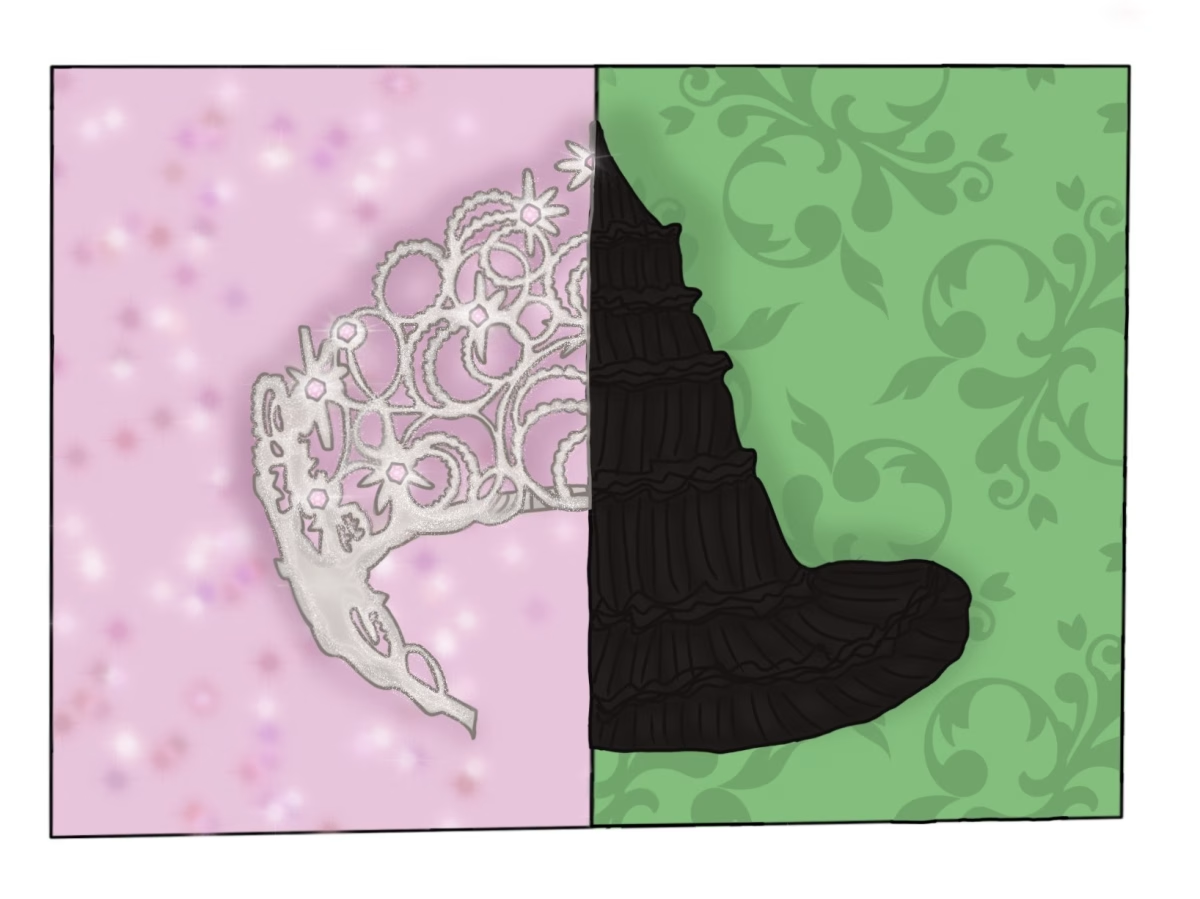
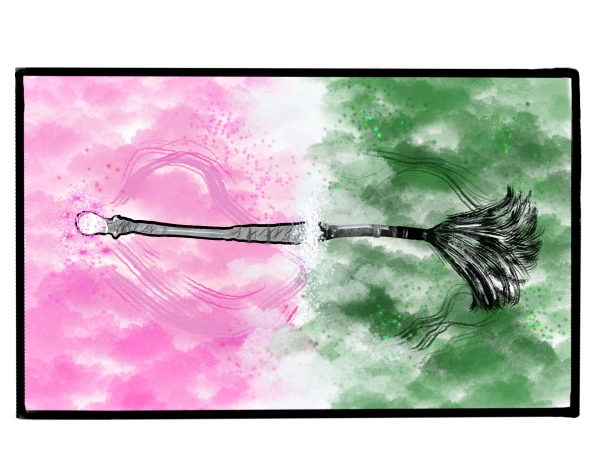
Ella: The movie opens with animals slaving away to build the renowned Yellow Brick Road and soldiers yelling orders and abusing what used to be talking, self-aware citizens of Oz. Then, in a blur of green and black, the infamous Wicked Witch of the West flies in on her broom and frees the animals, continuing her vigilante quest for animal rights in Oz. Meanwhile her sparkly pink counterpart, Glinda, is relishing in her newfound fame as Oz’s face of “goodness.” Her advisor, Madame Morrible, is working overtime to keep up her appearance despite having heavy doubts in her ability to do magic.
I usually really like Michelle Yeoh because she’s an amazing actress and has starred in some of my favorite films, but in this movie, I thought she overdid the evil behind-the-scenes thing. The dramatic eye rolls, the huffing and puffing, and her attempts at singing, was just too much. You could tell she was acting, which, in this case, was almost cringey to watch.
Samantha: In both the case with Madame Morrible and the development of the rest of the stars, it is possible I went in too excited, too eager. The magic was there and the friendship between Glinda and Elphaba remains to be admirable. However, the chemistry between Elphaba and Fiyero felt extremely forced, and I am not sure their treehouse scene (if you know-you know) was as appealing as producers Marc Plat and David Stone intended.
Ella: Speaking of romance, part of Madame Morrible’s plot is to have Fiyero and Glinda wed as a publicity stunt; but the kicker is that Fiyero is still pining for Elphaba. Thus, the love triangle of doom commences: Elphaba inadvertently crashes their wedding, Fiyero leaves Glinda after seeing Elphaba for the first time since her disappearance in Wicked Part One, and then they have one of the hardest-to-watch romance scenes I’ve ever had the misfortune of seeing. Glinda, rightfully bitter and salty, retaliates against Elphaba by donating her dead sister’s shoes to Dorothy which ends in the two cat-fighting.
Seriously? Was the only way to create tension and conflict between two strong, independent, women protagonists was to have them fight over a man? Sure, the movie was based on the musical which was based on the novel by Gregory Maguire. But the movie took a lot of liberty with the plot; so it was frustrating to watch a beautiful friendship that was the heart of the entire first movie crumble in the face of just a tiny bit of a man’s attention. Also, Elphaba is NOT a girl’s girl.
Samantha: I unfortunately am still trying to unremember the treehouse scene as well. The choice to put Elphaba in the “cardigan,” while duetting “As Long as You’re Mine” with Fiyero? Interesting. Elphaba going for her best friend’s man so shortly after the wedding? Again, interesting. I’ve never watched the stage show myself, but according to my mom who watched Wicked on Broadway in 2003, the “homewrecker” vibe was not nearly as prominent.
Ella: I will say, however, I did enjoy the development of Dorothy and her crew. The stories of how each came to be were clever, but nevertheless predictable. Ethan Slater as the Tin Man was chillingly good as he played the heartless (literally!) metal man right. “March of the Witch Hunters” was cinematically and musically one of the best scenes in the movie. The song is one of the few that didn’t overuse musical motifs from the first movie. I found myself getting bored because every song had sounded the same as the one before. I had been craving that second act edginess that musicals typically embrace, and the darker turn in the “March of the Witch Hunters” was an appreciated refresher.
As Dorothy, the Cowardly Lion, the Scarecrow, and the Tin Man embark on their quest, Glinda rides on horseback to warn her former best friend of the target on her head. The ending of the movie was unsurprising, as you’d imagine. Even my 13 year old sister made all of the right predictions.
The two best friends end up splitting ways, embodying their respective perspectives on progress in society. Elphaba wanted immediate change; Glinda was content with gradual improvement. In order to have any change, though, Elphaba had to throw in her vigilantism for Glinda to succeed in reforming Oz. It was a bittersweet realization.
Also, what was that final scene? After countless successful efforts to oust animals from Ozian society, the two groups automatically celebrated with each other at the end without discomfort or hint of disdain, making it feel artificial and rushed.
Samantha: Similarly to what Ella mentioned, that is what I mean about the pacing feeling weird. Not to mention, Glinda seemed to get everything she wanted (except Fiyero), with what seemed like no consequences. I did appreciate how in the ending flashback to the Shiz days, Glinda whispers something to Elphaba, identical to the traditional Wicked musical posters seen all over social media in the days leading to the movie premier. I will say, The Wicked: For Good marketing team was definitely doing their job. Before the release of the movie, I saw ads on every platform possible: Tiktok, Instagram, magazines, my grandma’s email box, you name it.
Ending thoughts:
Samantha: Now, I am not saying don’t watch it. I understand that the crammed, hectic, feel of each act is similar to the original Broadway production, and that adds to the suspension of the movie as a whole (maybe it was appealing to OG fans?). But to me, the bounce from scene to scene, emotion to emotion, prevented me from fully being immersed in the plot; I didn’t quite feel the magic that was so obvious in the first one. Even so, I do still think this movie is culturally important. Dealing with complicated themes of loyalty, friendship, and risk, the movie definitely had a complexity different from the light-hearted vibe of Part One. Plus, many of my “what if?” questions were answered which I certainly appreciate. This said, I would suggest waiting for it to air on a digital platform, like Prime Video, to watch it. I would not go spend an absurd $19 (seriously when did the price get so high) on a movie ticket.
Ella: One thing I did enjoy was the heavier emphasis on the theme of fascism. The Wicked franchise had the perfect platform to showcase the cautionary tale of being complacent in an authoritarian regime, and while I don’t think they did enough to show its consequences, it serves as a good reminder. Especially in the current political climate, Wicked’s themes are uncannily relevant now— scapegoating, propaganda and fearmongering, the freedom (and absence) of speech— the similarities are striking. The danger in apathy for the condition of others begets a quest to target other vulnerable groups: first the animals, then the Munchkins, what next? It would be nice to show the consequences of staying indifferent to tyranny on everyone as it would only strengthen Elphaba’s conviction, rather than “animals deserve rights, too”.
Overall, Wicked: For Good wasn’t bad, but it definitely wasn’t good. I wasn’t a fan of the songs that strayed from the musical (“No Place Like Home” and “The Girl in the Bubble”) as well as the splitting of what could have been one amazing movie into 1 good and 1 mediocre movie. Like Samantha said, waiting to watch it on a streaming service is the most sensible thing to do.