

As Andew Carr ’27 takes a seat at his desk, keyboard clicks fill the room as he prepares for his upcoming congressional debate tournament. While he scatters through a mess of research papers, an article catches his eye: the current presidential administration has cut funding for many colleges. Scanning the affected universities, Carr frowns as he recognizes many colleges he once dreamed of attending and starts to wonder how this will affect his college applications in the coming year.
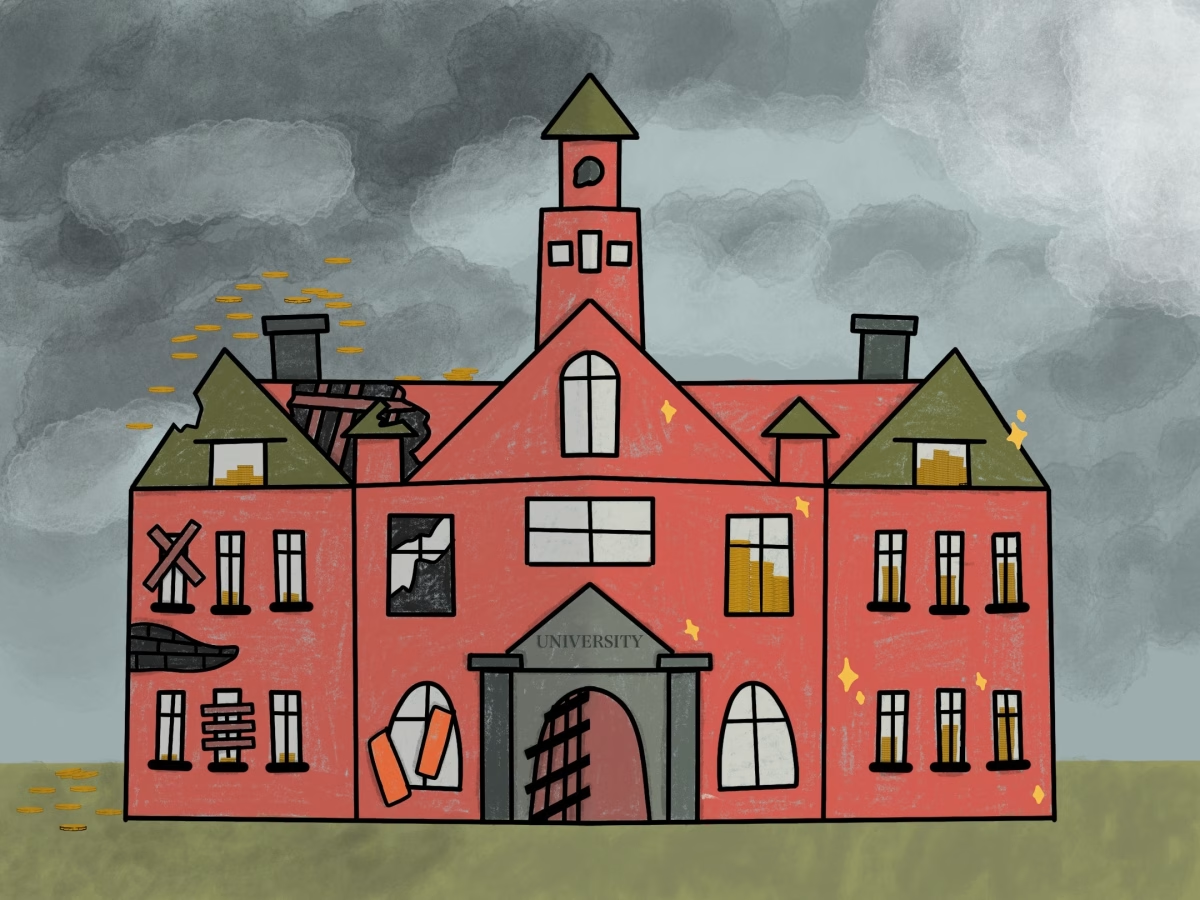
As of 2025, USA Today reports that the Trump Administration has started to withhold funds from educational institutions and universities that are deemed to have “pushed critical race theory, transgender insanity, and other inappropriate racial, sexual or political content on children.” Schools such as Brown University, University of Pennsylvania, and Massachusetts Institute of Technology have lost funding due to accusations of still participating in diversity, equity, and inclusion (DEI) programs.
Associated Press News (AP) explains that as a result of these funding cuts, colleges have faced pressure, and therefore difficulty in relying on federal research funding as a large source of revenue. Believing that these budget cuts will heavily impact the colleges’ admission rates, as schools may see fewer classes, faculty, financial aid availability, and resources, Carr worries about how these changes may affect his future college career.
“I feel like admissions are going to become significantly more competitive,” Carr said. “I fear this would lower my chances of being able to get crucial educational opportunities.”
According to an article by the New York Times on Dec. 2, the Trump administration mandated the National Institutes of Health (NIH) to switch from its typical practice of paying research grants annually, to now paying all grants fully up-front in order to “increase NIH budget flexibility.” Although the mandate made the individual payments larger, it largely decreased the total quantity of grants available to be funded. Therefore, the NIH and National Science Foundation (NSF) have awarded fewer grants across the science and medical fields, which have led to shortened cancer and diabetes research, according to the same article.
The New York Times subsequently states that the research grant cut has mostly affected fellowships in four key areas: life sciences, psychology, STEM education and social sciences, all being cut by more than 50 percent. For students like Shruity Akkiraju, a sophomore at the University of Illinois Chicago, these cuts on funding could limit the future opportunities students, such as her, will have.
“As someone who is trying to pursue pre-med path research, especially during the undergraduate years, it is extremely important and imperative to not only get into medical school, but also to be prepared to excel,” Akkiraju said. “The fact that funding could be cut for crucial opportunities in my career path really makes me worry about what I could miss out on.”
Akkiraju said she fears for the possible changes due to her commitment and effort towards something she is passionate about. Outside of the college experience, students still in high school, like Carr, also stress and worry due to the uncertainty of these cuts and how it affects what colleges they will apply to.
“If schools are being forced or pressured into situations where programs are being paused and admissions are being cut, then the colleges are not in the most stable position,” Carr said. “That makes me concerned for my future because those colleges affected are probably some of the schools that I might end up attending.”
During the college admissions process, Bold, an organization dedicated to eliminating student debt, found that 58 percent of American families rely on scholarships to pay for some college tuition costs each year. In addition, the average amount of aid for first-time undergraduates is about $14,890 per year through scholarships and grants. Sara Hanson, a post-secondary counselor for Stevenson’s College Career Center (CCC), has noticed feelings of unease for students if financial aid opportunities are not guaranteed. Therefore, Hanson believes these changes to college funding have led many students to reconsider their future college, especially when it comes to tuition.
“There are conversations that are happening with my juniors right now about the cost-saving benefits of starting at a community college,” Hanson said. “With the increases in inflation, coupled with external factors, families are starting to think a little differently about which colleges they want to attend because some have just skyrocketed in cost.”
To help students navigate these concerns about college debt, financial advisor Dan Maga runs a company called American College Funding, based in Lake Forest, Illinois. Every year, he works with parents of juniors and seniors in high school to manage their Free Application for Federal Student Aid (FAFSA) form and other financial aid applications. Maga’s recommendation for all families is to prioritize applying to colleges that are the most likely to provide aid for their students, no matter the post-secondary admission changes.
“If families have to borrow more than 20 thousand dollars a year, they have to go through a private lender and those rates and loans will be unknown,” Maga said. “Getting grants and scholarships out of schools would be for their best interest.”
Recent trends reported by the US News and World Report in the 2024-2025 and 2025-2026 academic years showed tuition rates at private national universities increasing by 5.6 percent, while in public schools, tuition costs rose by 4 to 4.7 percent. Carr notices that rising college costs have narrowed the range of schools that students feel they can realistically attend, hurting their ability to explore out-of-state options.
“I feel like my view of the future has shifted,” Carr said. “I now picture myself going to an in-state school, such as the University of Illinois Urbana Champaign.”
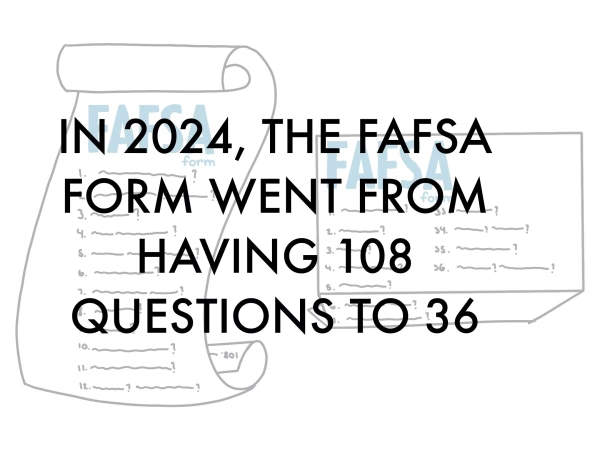
Amidst the increasing tuition, applications for financial aid have also been altered. According to an article by CollegeData, an online college advisor, In 2024, the FAFSA Simplification Act lowered the number of questions from 108 to 36. While the act increased the income protection allowance, the amount of income excluded from deciding a student’s financial aid, it stopped taking in consideration other factors of students’ lives.
“They no longer calculate how many students you have in college at the same time, which affects families that have multiple kids at college at the same time,” Hanson said.
However, the structural changes aren’t limited to FAFSA’s application. President Trump’s Big Beautiful Bill, which will take effect in the 2026-27 school year, will lower the amount of money families can receive for a federal loan.
“Parents used to be able to borrow 50 thousand to 60 thousand dollars a year, but starting next year, the given loans are going to be capped at 20 thousand a year,” Maga said.
With these changes, Maga says that he has to prepare his clients for unknown circumstances that might impact their finances, such as loan caps. Students like Shah have found professional guidance, like Maga and Hanson’s, to be helpful in offering a clear map for their future.
“My college counselor has helped break down tuition, housing, food, and fees, which has provided me a lot of clarity on what schools would be feasible to go to,” Shah said. “I’ve also been given useful feedback from my counselor, such as applying to more external scholarships and not relying on the universities alone.”
While many students share they often feel worried about their future, Hanson believes that it is her job to help navigate them through these drastic changes. She shares that although the budget cuts may cause students to take more precautionary measures, students will still be able to achieve their desired post-secondary goals.
“It’s tough to not have a knee-jerk reaction to this, and I am constantly in professional development trying to understand the changes and the impact,” Hanson said. “However, I believe we just have to trust in the process, knowing that even though changes are happening and might impact you, we’re trying to figure out how to help our students.”
Hanson, along with the other staff in the CCC, are working on how to best inform their students of these changes. Nonetheless, Carr acknowledges that change is ever-present and he feels confident in Stevenson’s ability to help their students.
“It’s obvious that the college system is going through a lot of change, but all in all, change has always been in the college admissions process and students have always gotten through it, so now should be no different,” Carr said. “I know I’m always going to have support for me from my parents as well as Stevenson’s CCC counselors, who have helped me navigate the changes throughout the year.”