

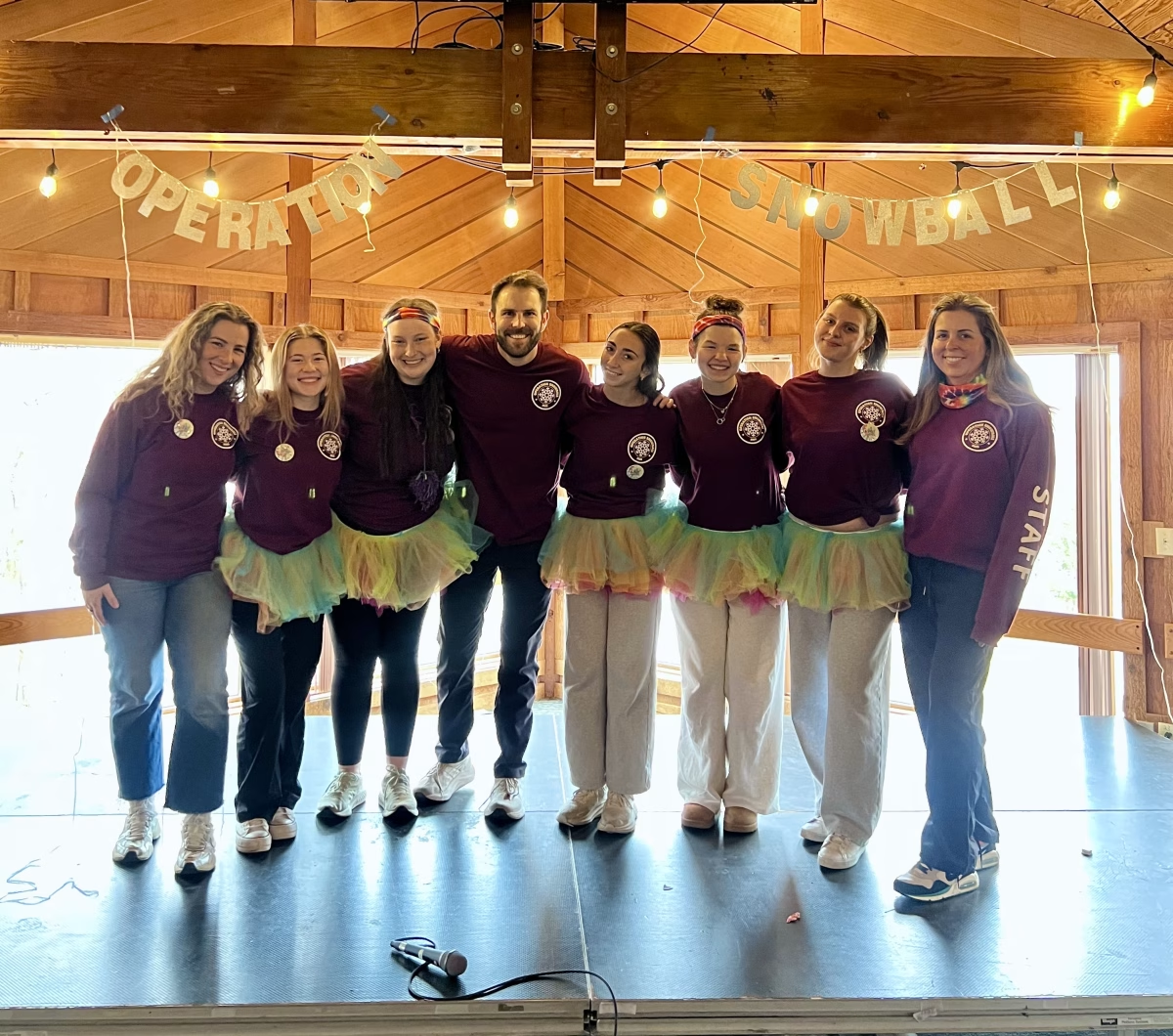
From Nov. 20-22, Operation Snowball students and teachers headed to Camp Timber-lee in East Troy, Wisconsin for its annual overnight winter retreat. Participants and leaders spent the two-and-a-half days away from school engaging in indoor and outdoor activities aimed at promoting team building and open discussion.
With 139 participants, 27 leaders, five directors, and 17 teacher chaperones, Operation Snowball completely sold out, seeing their highest number of attendees since the COVID-19 pandemic in 2020. Director Meredith Steciuk ’26 attributes this increase in demand to more representation across grade levels among their staff.
“Ever since I’ve been on staff, it’s always been mainly juniors and seniors,” Steciuk said. “But this year we had staffers of all grade levels. We had a lot of sophomore boys, a lot of junior girls and boys, and then a lot of senior girls, and that mix really worked out for us in terms of high attendance.”
During the annual retreat, staffers on Operation Snowball were responsible for leading their small groups in a variety of games and activities. On the first day at Camp Timberlee, participants met the other students in their group and decorated their rooms in accordance with their respective team theme. On the second and third days, students explored a variety of games and competitions: from Karaoke to a real-life Dress to Impress fashion show. Operation Snowball sponsor Tommy Wolfe believes that the wide variation of activities contributes to the retreat’s uniqueness.
“We purposely don’t give the full itinerary and everything for Snowball, but overall it’s a mix of large group activities with your choice of more outdoorsy games or crafty activities, small group activities led by our student leaders, speakers, and some other truly unique events,” Wolfe said.
In addition to the team-building games, Operation Snowball also provides open discussions, allowing for students and teachers to share advice and experiences in school. For participant Elisa Berrios Parker ’26, these activities helped her to connect with both new and old friends on a deeper level.
“There was an activity where you cross the line to answer a question if you have a dog or something similar, but as it continues the questions get more personal and vulnerable,” Parker said. “Sometimes you see the friends who you’ve known for years cross the line to something you never thought they would have related to. I got to really know the people I’m already close to even better.”
According to Wolfe, the retreat would not have had the emotional impact Parker refers to without the dedicated preparation of Operation Snowball’s student leaders. Behind the scenes, since the beginning of the school year, staff and directors have met every Tuesday leading up to the trip.
“There are sessions where our staff, usually upperclassmen that run the seven to eight small groups, will meet for an hour and a half to plan the events,” Wolfe said. “And then we have directors, which are five executive board members, who will also stay an hour after that meeting to help us plan the logistics and everything.”
Steciuk believes that the club’s hard work has paid off, as she finds the retreat is set apart from other clubs’ events at Stevenson due to its tight-knit community amid a large school environment. To her, the unique strength of the relationships created made the event special.
“Snowball’s purpose is to give students a more welcoming environment, because Stevenson is so big, and the retreat allows Stevenson to feel so much smaller,” Steciuk said. “The goal is for students to get out of their comfort zones as well. At the end of the retreat, you are so close with so many people, you meet so many new people, and the connections just never die out. That’s what’s so magical about Snowball.”
Parker believes that the retreat can also have impacts on one’s ability to form connections outside of the event. Since joining Operation Snowball her sophomore year and finishing her last retreat as a senior this year, Parker recalls how her own mindset towards building community has changed.
“Snowball just made me more open to other people and since then I’ve just wanted to meet and talk to new people more often,” Parker said. “I think it’s made me a little more creative too in a sense because of all the activities we did. I wouldn’t have done those activities without Operation Snowball.”
Although Operation Snowball’s main retreat has concluded, the club is looking to provide more community-building opportunities in the spring. Specifically, Wolfe notes that a new event created last year will likely be returning,
“Since Snowball has grown in popularity, we’ve thought about ways that we can expand it,” Wolfe said. “One thing we’ve started last year is Snow Blitz, which was a smaller Snowball-like activity and so we’re hoping to do some type of event this spring as well.”
Wolfe refers to the March event after school where Operation Snowball club members participate in more community workshops, listen to guest speakers, and are served a pizza dinner. Held at Stevenson until 9:45 p.m, the event serves to provide an extension to the main winter retreat.
Looking back on her three years with Operation Snowball, Parker urges every student to attend either the retreat or Snow Blitz at least once. As a senior, she shares that she is grateful for the connections she’s made through Snowball, and is confident others will find similar rewards.
“If you’re ever feeling like you’re alone in something, you’re really not,” Parker said. “Operation Snowball is 100 percent going to show you that you’re never alone in your struggles.”