

In his inaugural address on Jan. 20, President Trump declared the U.S.-Mexico border the site of a national emergency, pledging to halt all illegal entry and reinstate his “Remain in Mexico” asylum policy. Under this proclamation, which aimed to reinstate policies from his previous term in office, the Department of Defense and the Department of Homeland Security were directed to deploy immigrations and customs officers to the border to oversee entries from Mexico.
The Department of Defense and the Department of Homeland Security were given “complete operational control” of the border through Executive Order 14159, which authorized the military to support transportation and detention of undocumented immigrants. Additional orders target asylum eligibility and detention centers, barring individuals from claiming protection if they arrive from other countries without documentation or do not arrive at a legal port of entry.
Following these changes to border operations, the Trump administration has rolled out a new set of entry regulations regarding refugees and skilled workers on visas, including the H1-B visa that is held by foreign workers in specialty occupations. According to the White House website, companies are now required to pay $100,000 for each skilled worker that they hire from outside the country through the H-1B visa program.
“I came to this country to participate in the American dream, to be able to do something more meaningful for the world,” Mahit Chaudhary*, manager at a major insurance firm, said. “ But with the new restrictions on the H-1B visa, it seems like the dream is shattered.”
Before moving from India, Chaudhary went to a university to get his degrees because he wanted to work in the technology industry. However, after living in the U.S. for almost two decades, Chaudhary suddenly feels he has no future in the country as the government places greater monetary barriers for companies hiring through the H1-B program; he feels that companies are now less likely to hire people with his skill set from outside the country.
According to NBC, Bill Hing, professor of Law and Migration Studies at the University of San Francisco, says the mandate that applications for H-1B visa renewals must take place in the applicant’s home country means the process to remain in the country through the visa is now more time consuming and costly as well.
According to the U.S. Citizen and Immigration Services, when nonimmigrant workers, people in the country for a specific temporary purpose, are no longer employed, they have 60 days to leave the country unless they file an application to change their immigration status or petition to change employers. One mother, a family friend of Eshi Haranal ’27, left the country because she was no longer able to stay through the H1-B visa without a job.
“She recently found out that her H-1B visa got revoked and her entire family had to go back to India,” Haranal said. “One of her younger children, who’s a kid that I know from a dance class, didn’t understand what she was going through because obviously she’s a child.”
Haranal says the big move was shocking for the little girl, but she notices that many of the families moving to India are ones with young children. She believes parents do not want their kids to grow up surrounded by fear of deportation, and she noted that it becomes increasingly difficult for students to move to a different country the older they get.
Another family that she knows also moved back to India, however their high school-aged daughter was unable to gain admission to a school due to the fact that they moved in the middle of the school year.
While families Haranal knows return to their home country, Angie Zayas ’26* notes that the changes in immigration policy have caused families in her community to make plans for the possibility of deportation. The American Civil Liberties Union provides resources for immigrants to prepare for encounters with law enforcement, such as materials explaining constitutional rights and their family preparedness toolkit including guidebooks and wallet-cards. As a precaution, Zayas’ own family has also taken steps to plan for potential deportation.
“Now my mom is filing for custody of my little cousin, so in case my uncle does get deported, my mom’s going to have custody of my little cousin,” Zayas* said. “So it’s just really scary.”
According to the National Immigrant Justice Center (NIJC), prior to Oct. 7 of 2025, up to 1,100 out of 1,852 people arrested around Chicago by Immigrations and Custom Enforcement (ICE) were either deported or voluntarily left the country to avoid potential deportation. With Executive Order 14159 (also known as “Protecting the American People Against Invasion”), individuals awaiting trial and removal proceedings are required to be detained, leading to reports of detention centers operating at or beyond their carrying capacity.
The NIJC states that on Nov. 12, Judge Jeffrey Cummings ordered the Trump administration to release roughly 600 people who were believed to be arrested without warrants or probable cause from ICE detention centers, ruling that the arrests violated the Castañon Nava federal consent decree. While up to 615 people detained by ICE agents around Chicago could receive alternatives to detention, the ruling on their case is currently paused and pending appeal.
As hundreds of people in the Chicago area have been detained by ICE agents, Director of Orchestra Enrique Vilaseco focuses on kindness and open-mindedness towards others rather than hate.
“Immigrants that are undocumented are not illegal; we’re all citizens of this planet,” Vilaseco said. “We’re supposed to be compassionate—that’s what makes us great.”
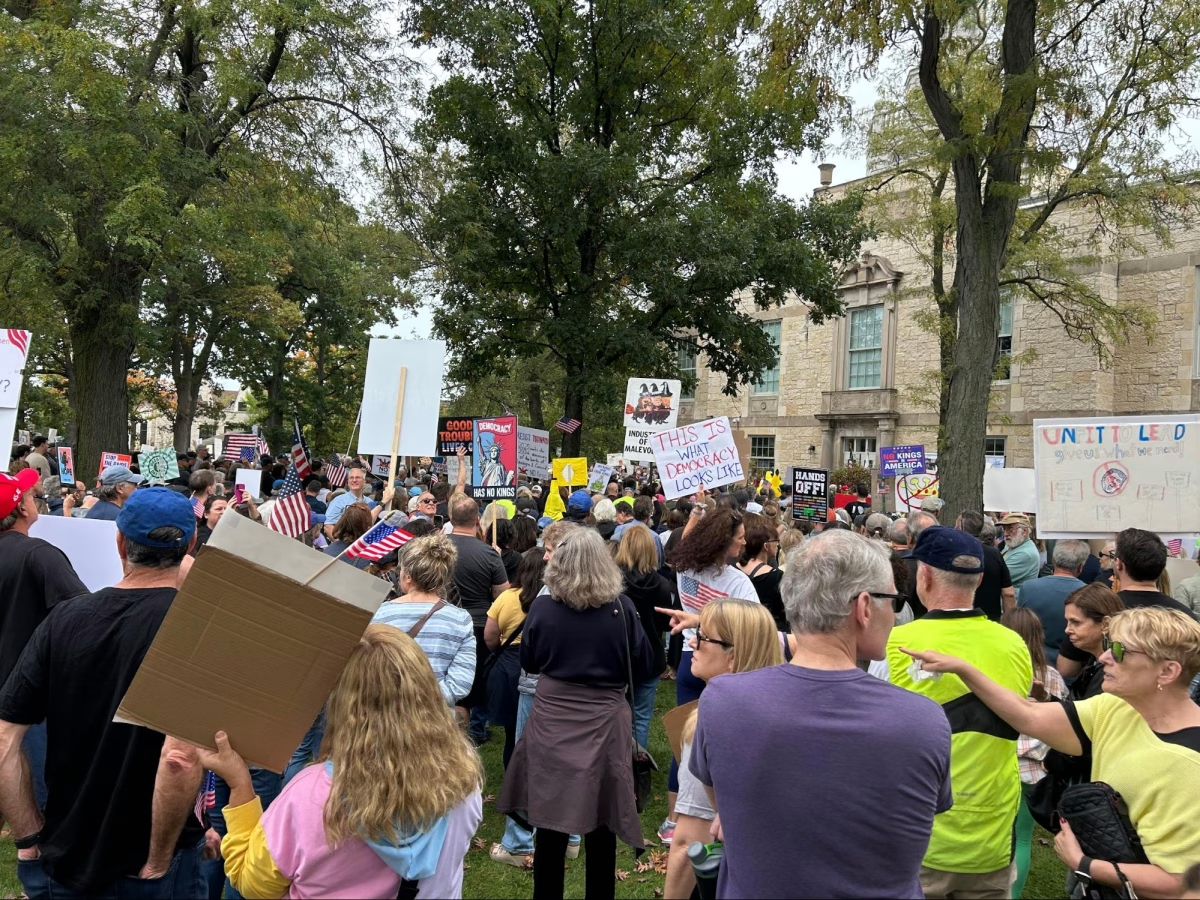
In class, Vilaseco hopes that students would feel comfortable to talk about their beliefs in an effort to promote students to become aware of the various social and political conditions within the community. Widespread awareness is also important to the “No Kings” movement, as according to the No Kings website, one way to get involved is by raising awareness on social media or by wearing “No Kings” gear. The website states that through the organization of nationwide peaceful marches and social media campaigns, the movement aims to defend democracy.
“Peaceful protest is the soul of democracy,” Chaudhary* said. “The government, however unhappy they are with the protest, has to accept that America is a free country, and it should remain that way.”
As reported by Britannica, nearly seven million people attended the “No Kings” protest on Oct. 18 nationally, and the preceding June protest drew roughly five million. This makes these the second and fourth largest single-day protests in the nation’s history, and the first and third largest in the past 50 years, respectively. According to the “No Kings” website, the movement aims to “continue to organize nationwide demonstrations.”
“The ‘No Kings’ protest has got to get bigger,” Vilaseco said. “And it’s got to be peaceful. We cannot let violence take over.”
The “No Kings” movement did not have a publicly detailed, unified policy platform with specific legislative demands, making it difficult to track concrete outcomes of the protest, according to Theresa Abigail ’26*. Abigail believes that the lack of a specific issue in the “No Kings” protests meant that the demonstrations will not lead to meaningful change.
“We saw all these people go out into the street and they protested, but there was nothing that happened after that,” Abigail* said. “Everyone put down the snarky little signs they made and they went to brunch.”
Abigail believes that compared to other movements including the Civil Rights Movement and LGBTQ+ rights movement, the “No Kings” protests did not have a clear goal. While Abigail thinks the object of protest was too vague to result in lasting change, Haranal is inspired by the overall meaning of seeing so many people stand together and peacefully protest.
“I feel like the fact that people are defending people and seeing them as humans instead of criminals is just a factor of how humanity has progressed,” Haranal said.
*Name changed to protect anonymity