

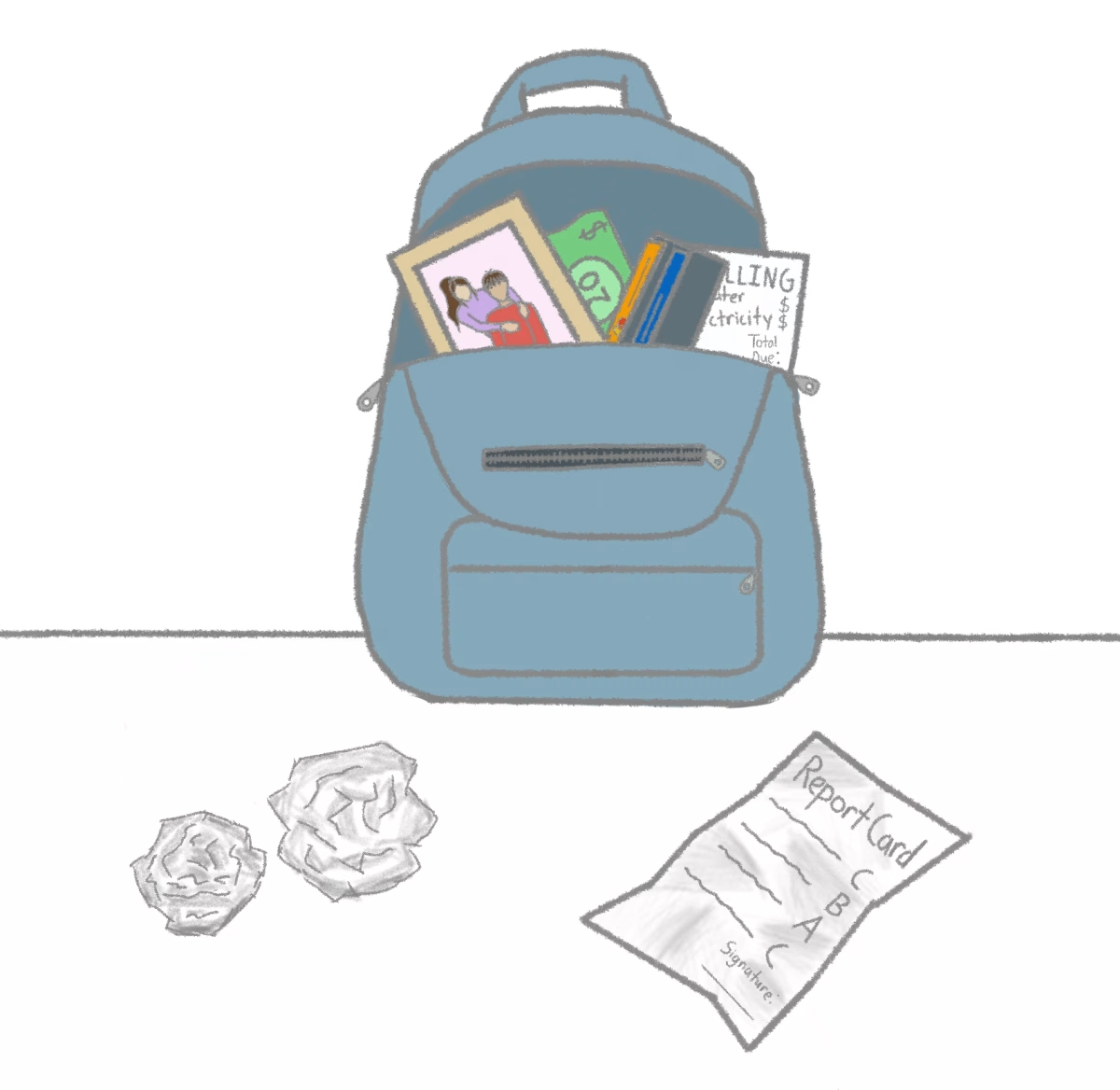
Dumping his backpack in his room, Rishi Singh* ’29 hurries back to the living room, shrugging off the weight of his mental to-do list just as easily as his backpack. He swiftly feeds his dog, putting off walking him until later—his priorities are set straight. Caring for his autistic twin brother comes first. And with that, the clock on what remains of Singh’s day begins to tick away faster and faster.
Along with everything a student has on their plate in terms of academics, many students also often face external factors outside of school that can impact their emotional well-being.
Some students have to work, while others might have to take care of their siblings. According to Mental Health America, this may cause the students to dedicate less time to their studies, leading to judgement from others who don’t know what they’re going through.
For students like Singh, these situations of judgement can cause them to distance themselves.
“I have to be emotionally strong because my brother has autism,” Singh said. “My parents are doing their best job handling me and my brother, but I’m still a kid. Sometimes, I have to act like I’m fine when I might not be because honestly, I don’t want people to feel bad for me.”
Although Singh acts unphased by the effort it takes to care for his family, it does take a large toll on his mental health. The American Physiological Association states that as many as 1.4 million children in the U.S. between the ages of eight and 18 provide care for an older adult or a sibling, exhibiting higher chances of difficulties in school and worse mental health. For Singh, these difficulties stem from the decision to not ask for help from his friends.
“I don’t want people trying to understand my situation,” Singh said. “I think it would put a burden on them, and I don’t want other people to deal with trying to put themselves in my shoes.”
Singh’s attitude toward others’ comprehension of his situation is echoed by Matt Carlsen* ’27. Carlsen was diagnosed with autism in seventh grade. Before and after his diagnosis, Carlsen has noticed a difference in the way people treated him, which prompted him to be more cautious about whom he shares his story with.
“No one’s going to tell me to work better, but there are definitely times when I’ll talk about having extra time for a test, and you’ll see hesitation because people look at me and they assume that I’m capable enough to not need these things,” Carlsen said. “But no one really knows what’s going on inside anyone’s head. People look at you a little differently when they know, and when you tell someone, they look at your actions through a different light.”
Social worker Christina Foss has seen experiences like Carlsen’s before, in terms of empathy. Foss is the leader for the grief support group, which is one of many support groups that meet weekly during class periods for students to hear other students with similar struggles.
With around 15-20 students attending weekly, these 13 support groups focus on bringing students in similar situations together to create a safe space for students to share their experiences. Foss describes several instances of ignorance for people’s home lives shared in these support group meetings, hoping people end up taking away the idea of being mindful towards others.
“I wish everyone could operate on a universal precaution that none of us can possibly know what is on someone’s plate,” Foss said. “We have 5,000 humans walking around each other, you never know who or how many people are carrying things with them that they are struggling with. Just be mindful to not assume they are lazy or do not care, it’s really important to recognize that people are grieving, and they aren’t always willing to talk.”
Even if it means they have to hide how they feel, Carlsen and Singh typically avoid sharing their experiences like Foss believes. Shriya Anand* ’27 relates to this reluctance to share everything that goes on outside of school for her; specifically being a part of a single income household.
“Scores are the first thing other students ask you when they see you, and some people don’t feel comfortable with that or don’t want to share,” Anand said. “It’s taken me a while to say no. I used to just say my score, and they used to be like, ‘oh that’s all you got?’ Then, it wasn’t private information anymore. Sometimes it feels like I’m a bit behind, and everyone got started a bit earlier than me as well.”
Carlsen relates to the feeling of falling behind, and worries that he is not always caught up with everyone else. Carlsen believes that the school community’s competitive culture makes it difficult to ask for help.
“Socially I can’t really ask for help, especially when I’m talking to people,” Carlsen said. “I guess from these competitive environments and people who are very competitive about their grades, there is an expectation that you do well and you kind of just do that in your own way and that you don’t reach out and try and build off others, because Stevenson’s very individualistic. At the end of the day, people are worried about themselves.”
Similarly to Carlsen, other students may also feel the same hesitance to try and ask for support from their peers. Scientific American did a study of student behavior in classes, resulting in students often refusing to ask questions in front of their peers, because they were worried their classmates would think they were “stupid.” Anand experiences similar judgement when it comes to seeking help in school, relating to this sentiment.
“I feel like there’s a big stigma in the school of asking dumb questions,” Anand said. “No question is dumb, right? But when you ask a really simple, easy question, like a basic question in class, it is really looked down upon, even if it’s important.”
Like most students, Anand feels the same pressure to always be on top of their academics. Carlsen tries to make the best out of these situations by focusing and working on what he can control, rather than being nervous about issues beyond him.
“I personally see school as going to my classes, doing my best in those classes, and it is what it is at the end of the day,” Carlsen said. “I am more scared of wasting my high school experience because of burning myself out and living my high school experience in a state of anxiety, than I am of those bad grades I could get. I feel like that kind of goes against half of the people of Stevenson and what they kind of stand for.”
Carlsen takes pride in his ability to prioritize his own enjoyment. Anand also tries to have a positive experience, yet claims that this drive to prevent herself from falling behind makes her feel like she has too much to lose.
“There’s a pressure in my life that makes me [feel like I cannot] perform less than my full potential in school, if that makes sense,” Anand said. “I feel like the financial and the mental stress that comes with trying to be better is really hard.”
Anand believes that everything that she does is motivated by her family’s income. Through the teenage lens, though, she describes feeling left out of her high school life because of her priorities being different.
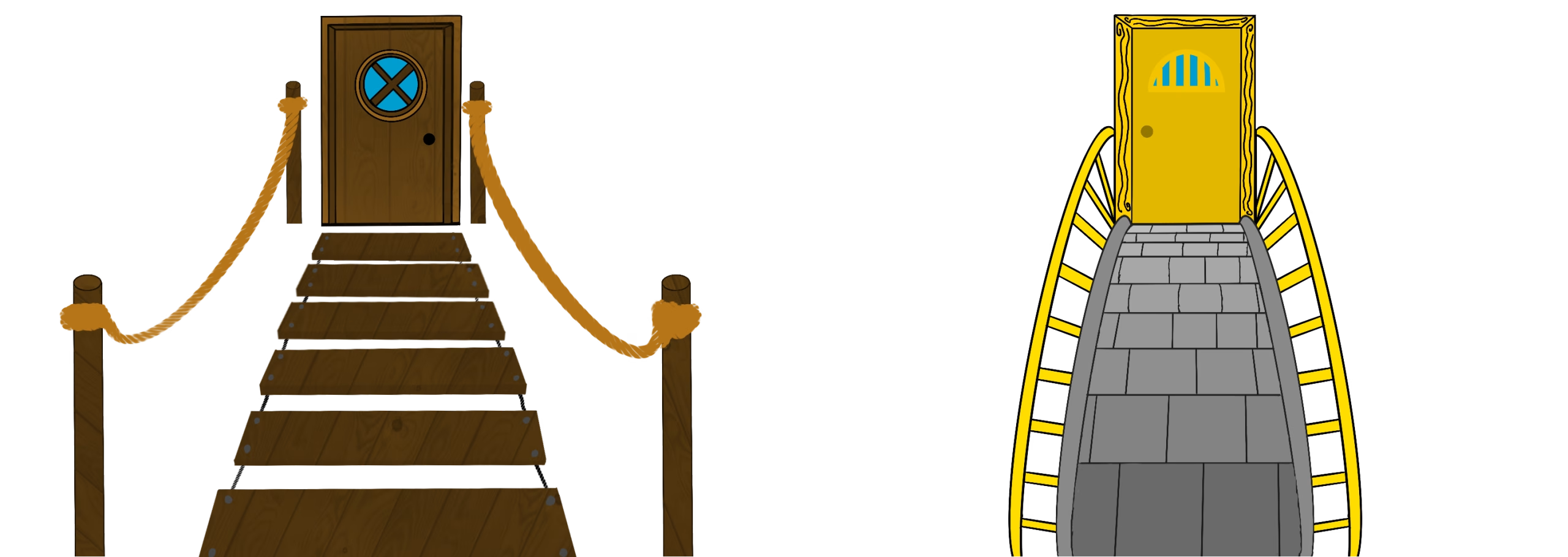
“As a teenager, you obviously want to procrastinate, watch TV shows, go to concerts etc.,” Anand said. “But I feel like when you have to prioritize something else like how much you spend in a day, you’re only living your life on the backlog. Experiencing teenage years is a thing my parents constantly say that I never enjoy in my life, which is kind of bad because I lose out on the high school life I have for priorities of my family.”
Despite compromising on her wants, Anand tries to make up by keeping her priorities straight. For her, that means utilizing the Information Learning Center (ILC) tutor program as much as possible when helpful because of the free cost.
“Yeah, I feel like the tutors used to help a lot,” Anand said. “I just don’t go a lot anymore just because some of the peer tutors don’t know as much as we need them to. It’s hard to know when I can go for the classes I need and some of the tutors are always busy.”
While Anand doesn’t find fulfillment in this school program currently, Singh finds that other programs like Stevenson clubs help him with his home life and balancing everything. Singh believes that Best Buddies, a club that promotes one-to-one friendships with students with intellectual and developmental disabilities and students without disabilities, helps understand his life more.
“On Monday, I have Best Buddies,” Singh said. “That obviously ties back to my brother, and I guess it helps me understand him better. He’s on the spectrum. There’s a wide range of severity it can be, and I work with someone on the higher end of the spectrum. It makes me understand him better, like his behavior and everything about him that I wouldn’t understand otherwise.”
Carlsen supports Singh’s opinion on clubs like Best Buddies, sometimes feeling like it categorizes the needs of a student with autism or a disability, even though needs can vary student to student. He believes that this perpetuated image can lead to false impressions on the needs of different people on the spectrum.
“I think these clubs are great because it helps to almost paint this picture of, yeah, that’s what someone who needs help looks like,” Carlsen said. “There’s nothing negative about that, but I feel like it’s more so the idea that when people look at this idea of somebody in need of more help, that is not the case for every person with autism, which makes talking about it harder.”
Along with understanding his sibling, Singh has explored ways to connect with other students with similar experiences. Support groups like middle school programs or potentially Stevenson’s Coping With Family Stress have given Singh comfort within his outside life.
“In middle school, my brother’s teacher actually set up a support group with me and a few other students who also had siblings like mine,” Singh said. “So that was a pretty fun experience talking about things, and having stuff in common. I’m pretty open to exploring Stevenson’s support groups too.”
Support groups, as Singh mentioned, have been ways Stevenson supports their students when they deal with these external factors. Foss observes successes from the community built in the support group she oversees.
“It is a beautiful phenomenon when people see they are not alone through these groups, they do not need to have all the answers right now, and they understand that,” Foss said. “Students meet people that they may have never encountered or been friends with, and that can be super revolutionary in their healing journey. People are reluctant but it can make the world feel less lonely at least for one period in that week, and they realize they aren’t alone in the big pond of Stevenson.”
As Foss values the healing that results from these groups, Singh appreciates the connections with others through his brother. The future of his twin always lies at the back of Singh’s mind; he uses his sibling to influence every decision he makes.
“I feel like my brother kind of motivates me that I just work harder,” Singh said. “When my parents pass away, who’s gonna take care of my brother? It has to be me.”
*Names changed to protect anonymity